Social Media Algorithms: How They Shape Our Perception of News and Entertainment
Every time you open Instagram, TikTok, YouTube, or X, an invisible system is making thousands of decisions about what you see first — and what never reaches you at all. These decisions aren't random. They're driven by social media algorithms, and understanding how they work is one of the more important pieces of media literacy anyone can develop right now.
What Is a Social Media Algorithm?
A social media algorithm is a set of computational rules that determines which content appears in your feed, in what order, and how prominently. Instead of showing posts chronologically, platforms use these systems to predict what you're most likely to engage with — and serve that first.
The shift from chronological feeds to algorithmic ones happened gradually across major platforms between 2012 and 2016. Facebook made the change early; Instagram followed; Twitter (now X) eventually did too. The stated reason was always the same: there's too much content for users to process, so the algorithm helps surface what matters most to each individual.
That framing is partly true. Algorithms do reduce information overload. But they also reflect a business incentive: the longer you stay on a platform, the more advertising revenue it generates. This is the foundation of the attention economy — a system where your time and focus are the product being optimized for, not your satisfaction or your access to accurate information.
How Algorithms Decide What You See
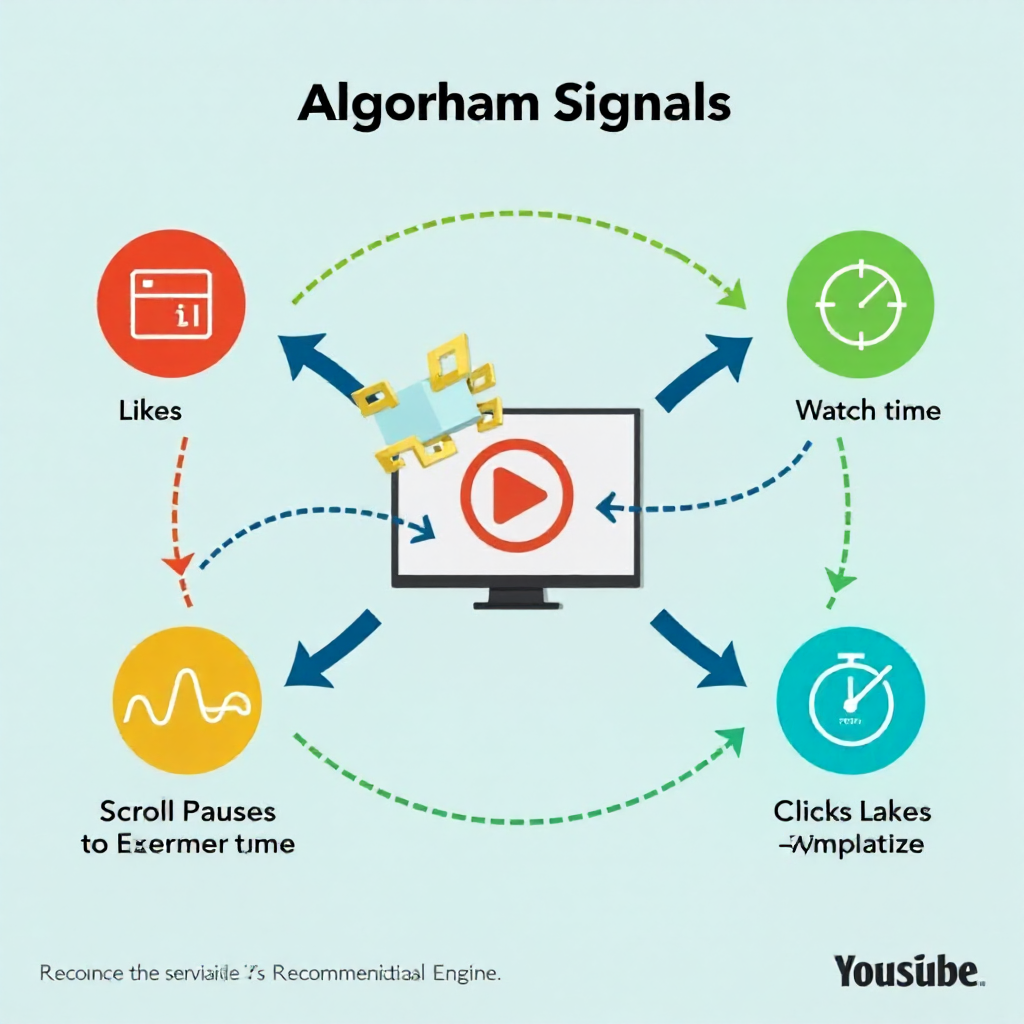
Algorithms rank content using a combination of engagement metrics and user behavior signals — the two primary inputs that tell a platform what you care about.
Engagement metrics include obvious actions: likes, shares, comments, and clicks. But modern recommendation engines go much deeper. They track how long you pause on a post before scrolling, whether you watch a video to completion or drop off at 10 seconds, which profiles you visit without following, and even how quickly you return to the app after closing it.
These behavioral signals train the algorithm over time. The system builds a model of your preferences — often more accurate than your own self-description — and uses it to populate your content feed. Content that matches your historical behavior gets amplified. Content that doesn't gets buried, regardless of its accuracy or importance.
Content type also plays a role. Video consistently outperforms static images on most platforms because it captures more watch time. Emotionally charged posts — outrage, awe, humor — tend to generate more shares than neutral ones. The algorithm doesn't evaluate whether content is true or constructive; it evaluates whether it performs.
The Filter Bubble Effect and Echo Chambers
The filter bubble is what happens when personalization becomes so refined that you stop encountering perspectives different from your own. The term was coined by internet activist Eli Pariser in 2011, and the phenomenon has only intensified since.
Here's how it develops: you engage with content that aligns with your existing views. The algorithm registers this engagement and shows you more similar content. You engage again. The cycle repeats until your feed becomes a curated reflection of what you already believe, stripped of the friction that comes from encountering disagreement.
The echo chamber is the social dimension of the same problem. Where a filter bubble is about what the algorithm shows you, an echo chamber is about the community that forms around shared content. When people are repeatedly exposed to the same ideas, reinforced by peers who share them, those ideas harden into unquestioned assumptions. Dissenting voices don't just get fewer clicks — they get socially penalized within the community.
It's worth separating these two concepts clearly, because conflating them leads to misdiagnosis. Filter bubbles are algorithmic. Echo chambers are social. Both can exist independently, but algorithms accelerate the formation of echo chambers by controlling who and what gets seen.
Algorithms and the Spread of News — Accuracy vs. Engagement
When it comes to news consumption, the core tension is this: accurate, nuanced reporting rarely performs as well as sensational or emotionally provocative content. Algorithms optimized for engagement don't distinguish between the two.
A 2018 MIT study published in Science found that false news spreads significantly faster and farther on Twitter than true news — not because of bots, but because of human behavior. False stories tend to be more novel and emotionally arousing, which drives sharing. The algorithm, reading those shares as a signal of quality, amplifies the content further.
This is the misinformation spread problem in its clearest form. The algorithm isn't designed to lie. It's designed to maximize engagement. But those two goals can produce the same outcome: a feed where a misleading headline about a health scare outperforms a careful, sourced correction published hours later.
Platform bias compounds this. Platforms tend to favor content formats that generate the most time-on-site — video, live content, emotionally charged posts. Dry but accurate policy reporting doesn't compete well in that environment. The result is a structural disadvantage for the kind of journalism that democratic societies arguably need most.
Entertainment Recommendations and the Rabbit Hole Problem
Recommendation engines in entertainment contexts — YouTube's "Up Next," Netflix's autoplay, Spotify's radio features — are built to keep you watching or listening. They're remarkably good at it. They're also capable of pulling users into progressively more extreme content without any single dramatic step.
The mechanism is gradual escalation. If you watch a video about extreme sports, the next recommendation might be slightly more dangerous. If you watch political commentary, the algorithm may test whether more provocative takes hold your attention longer. Each step is small. The cumulative drift can be significant.
Researchers have called this the "rabbit hole" effect. It doesn't require malicious intent from the platform — it emerges naturally from optimizing for watch time. Content that creates a strong emotional response tends to hold attention. Content that escalates intensity tends to create stronger responses. The math, left unchecked, points in a consistent direction.
This affects not just what people watch, but how their tastes and expectations shift over time. Regular exposure to high-intensity content raises the baseline threshold for what feels engaging. Moderate, balanced content starts to feel boring by comparison — which the algorithm then registers as low engagement, and shows less of.
The Broader Impact on Society and Public Discourse
Individually, these dynamics affect what any one person believes and how they spend their time. Collectively, they reshape public discourse in ways that are harder to reverse.
Polarization is the most frequently cited consequence. When large groups of people consume algorithmically curated feeds that reinforce their existing beliefs and rarely expose them to credible opposing perspectives, political and social divides widen. This isn't a partisan observation — research from institutions including the Pew Research Center has documented increasing ideological sorting in news consumption across the political spectrum.
There's also a growing distrust of media that algorithms partly accelerate. When people encounter misinformation that later gets corrected, or notice that their feeds seem to confirm their biases, they often conclude that all media is manipulated — rather than recognizing the algorithmic layer as the distorting factor. The result is a paradox: the system that spreads misinformation also erodes trust in the institutions best positioned to correct it.
None of this means algorithms are inherently destructive. They solve real problems — discovery, relevance, personalization at scale. The issue is that the current optimization targets (engagement, time-on-site, click-through rates) don't naturally align with outcomes like accuracy, diversity of perspective, or informed citizenship. That misalignment is a design choice, and design choices can be changed.
What Can Users and Platforms Do?
Users have more leverage than most realize, and platforms face growing pressure to exercise theirs. Neither solution is complete on its own.
For individual users, the most effective strategies involve deliberately disrupting the feedback loop:
- Actively search for and follow sources that represent perspectives different from your own — the algorithm will eventually incorporate those signals
- Use platform controls where available: YouTube's "Don't recommend this channel," Facebook's feed preferences, or Twitter's chronological mode
- Treat your engagement as training data — pausing on content, rewatching videos, and clicking links all teach the algorithm what to show you next
- Supplement algorithmically curated feeds with direct subscriptions to newsletters or RSS feeds, which bypass recommendation systems entirely
On the platform side, the conversation around algorithmic transparency has gained real traction. The EU's Digital Services Act, which took effect for large platforms in 2024, requires major social networks to offer users at least one feed option not based on profiling. Researchers are pushing for algorithmic auditing — independent access to study how recommendation systems affect different user populations.
Some platforms have begun experimenting with "friction" — small interventions like prompting users to read an article before sharing it, or labeling content from sources with a history of inaccuracy. Early evidence suggests these nudges can reduce misinformation spread without significantly hurting engagement. They're not transformative, but they demonstrate that the engagement-accuracy trade-off isn't as fixed as platform defaults suggest.
The deeper question is whether the attention economy model itself needs to change — whether platforms can build sustainable businesses around metrics that better reflect user wellbeing rather than raw time-on-site. That's a structural challenge, and it won't be resolved by any single feature update. But awareness is where individual agency begins, and understanding how these systems work is the prerequisite for everything else.
Frequently Asked Questions
Why do I keep seeing the same type of content on my feed?
Your content feed is trained by your past behavior. Every pause, like, click, and share signals to the algorithm what to show you more of. Over time, this creates a self-reinforcing loop where similar content dominates because it consistently generates your engagement.
Can social media algorithms be biased?
Yes. Algorithms reflect the data they're trained on and the objectives they're optimized for. If engagement is the primary goal, content that triggers strong emotional responses — regardless of accuracy — tends to get amplified. This creates a structural bias toward sensational content over measured reporting.
What is the difference between a filter bubble and an echo chamber?
A filter bubble is algorithmic: the system limits what content reaches you based on your behavior. An echo chamber is social: a community reinforces shared beliefs and marginalizes dissent. Algorithms accelerate echo chamber formation, but the two phenomena are distinct.
Do algorithms treat news content differently than entertainment?
Most platforms don't apply fundamentally different ranking logic to news versus entertainment — both are evaluated primarily on engagement signals. Some platforms have created separate treatments for news (such as reduced algorithmic amplification of political content), but the core recommendation engine typically operates the same way across content types.
How can I diversify my social media feed to see more balanced content?
Follow sources and accounts that represent perspectives outside your usual consumption. Use platform-provided controls to adjust your feed preferences. Engage deliberately — the algorithm learns from what you interact with, so intentional engagement with diverse content gradually shifts what you're shown. Direct subscriptions (newsletters, RSS) are also effective for bypassing algorithmic curation entirely.